· ReadyStack
Worked example
Real numbers from this tool, line by line.
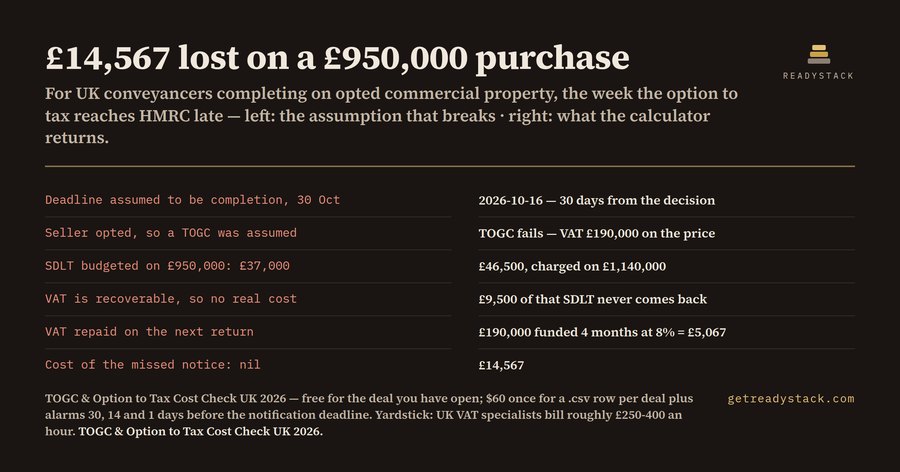
A conveyancer who notified the buyer's option to tax six days after completion cost the client £14,567 on a £950,000 warehouse — and the VAT on that deal was fully recoverable. The recoverable part is not where the money goes.
Here is the sequence. The seller had opted to tax, so the sale of the let building was a taxable supply unless it transferred as a going concern. For the TOGC to hold on opted land, two things must happen by the relevant date, which is normally completion: the buyer must opt to tax and notify HMRC, and the buyer must tell the seller that the option is not disapplied under Article 5(2B) of the VAT (Special Provisions) Order 1995. The buyer's decision must also reach HMRC within 30 days of the decision itself. On this deal the decision was made on 16 September and completion was set for 30 October, so the binding date was 16 October — the 30-day clock, not completion. The notice went in after both.
The TOGC failed, and VAT of £190,000 became chargeable on the price. A fully taxable buyer recovers that, so most people stop worrying there. They should not, because SDLT is charged on the consideration actually paid, and when the TOGC fails the consideration includes the VAT. England and Northern Ireland non-residential rates are nil up to £150,000, 2% to £250,000 and 5% above. On £950,000 that is £37,000. On £1,140,000 it is £46,500. The difference, £9,500, is 5% of the VAT and it is never recoverable from anybody — not from HMRC, not from the seller, not from the lender. Then the £190,000 has to be funded until the repayment return lands. Four months at 8% is £5,067. Total: £14,567, created by a date.
Change one input and the picture changes shape. A partly exempt buyer — say a business that recovers 40% of its input tax — buying a £2.4 million office with no option to tax at all is looking at £480,000 of VAT, of which £288,000 never comes back, £24,000 of extra SDLT on the VAT, and £7,680 to fund the recoverable slice for six months. That is £319,680. Run the same deal where the option was notified in time and the seller holds the Article 5(2B) notice and the answer is zero: no VAT, no uplift, nothing to fund.
The reason this is worth a tool rather than a spreadsheet is that no free calculator asks the question. HMRC's SDLT calculator takes a single figure. It cannot know whether VAT sits inside the consideration, because that depends on two notifications neither of which is a number. So the standard completion statement shows SDLT on the headline price, and the uplift only appears when the return is filed — by which time the date has passed and the option cannot be backdated.
The extension does the whole calculation in the popup or on the web page, free, for any deal: it takes the earlier of the two deadlines and shows it as a date, gives a verdict on whether the TOGC holds, and prices the VAT, both SDLT figures, the permanent uplift, the irrecoverable share and the funding cost — nine outputs from nine inputs, with no key, no watermark and no usage limit.
A caveat worth stating plainly: this prices arithmetic, not title. Whether a letting is a going concern, or an anti-avoidance rule disapplies an option, are advice questions, and UK VAT specialists bill roughly £250-400 an hour to answer them. What the tool removes is the failure mode where nobody was wrong about the law and the client still lost £9,500, because a notice went to HMRC in the wrong week. The rules are in VAT Notice 742A. Scotland and Wales charge LBTT and LTT instead, so the band arithmetic here is England and Northern Ireland only.
Questions people ask
What does this actually work out?
It prices a failed transfer of a going concern on opted UK commercial property. You enter the price, the decision and completion dates, whether the buyer's option was notified and whether the seller got the Article 5(2B) notice. It returns the notification deadline, the VAT, both SDLT figures, the permanent SDLT uplift and the funding cost.
Who is it for?
Conveyancers and property solicitors in England and Northern Ireland, in-house property accountants, and buyers of opted commercial units, offices and warehouses. Anyone who has to answer the question a client asks at exchange: if this notice slips, what does it cost us, and by which date must it be with HMRC?
Why is a free SDLT calculator not enough?
Free SDLT calculators take a single price and stop. They never ask whether VAT lands on that consideration, so they cannot show the uplift, which is the part nobody budgets for. They also ignore the option-to-tax clock and the seller notice, which are what decide whether VAT applies at all.
What is free and what needs the key?
Every calculation is free, in full, with no key, no watermark and no usage limit: deadline, verdict, VAT, both SDLT figures, irrecoverable VAT and funding cost. The $60 key adds two things on a different axis: a .csv row you keep in the transaction file, and alarms 30, 14 and 1 days before the deadline.
What would this cost from an adviser?
UK VAT specialists bill roughly GBP 250-400 an hour, and a TOGC or option-to-tax review is rarely a sub-hour job, so a single second opinion on one deal costs more than the key. The extension does not replace advice on a difficult title; it stops the arithmetic being the thing that goes wrong.
Where do the rules come from?
The option-to-tax notification window and the TOGC conditions are in HMRC VAT Notice 742A and the VAT (Special Provisions) Order 1995, Article 5. The bands are the England and Northern Ireland non-residential SDLT rates: nil to GBP 150,000, 2% to GBP 250,000, 5% above. Scotland and Wales use LBTT and LTT instead.
Ask about this tool
One question, answered by the person who built it. Your email only if you want the answer sent.